
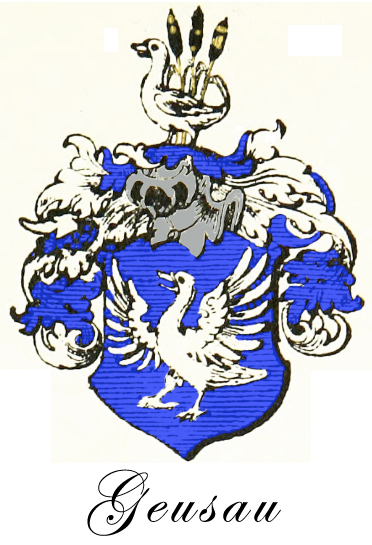
Does the original family name of Geusau have a meaning in language?German genealogists state that Geusau means “goose meadow” which came from the Wendish root word “huss” or “guss”, which in Saxon is "gós" and in German is "gans." The English word that morphed later is "goose" and "gosling." And, yes, the original heraldry for the family was a charging goose! It all began as early as 4,000 to 2,000 BC with the Proto-Indo-European (PIE) word ‘gha-,’ which means ‘to gape or yawn (extending the neck and opening the mouth very wide).’
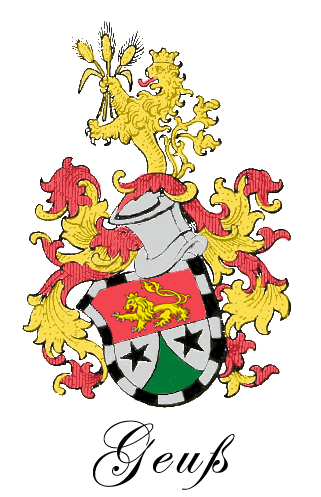
Why all the spelling variations in our family name?Based on my years of research, including speaking with multiple German linguists, our proper German family name is ‘Geuß’ (pronounced /gois/). The ‘ß’ is a ligature in the German alphabet called ‘Eszett’ (also called ‘scharfes S’ (sharp S)) and is the lexicalized expression for sz and the old blackletter ſz. Due to increasing informal use starting in the late 1800’s and the German spelling reform of 1996, ‘ß’ now officially represents ss. It should also be noted that family names frequently were changed by children to set them apart from their father usually for business reasons. For example Hans Nicolai Geuser had 3 sons: 1) Nicholaus Geuser in 1586, 2) Johannes Ludwig Geußer in 1589, and 3) Dietrich Geyser in 1591. Notice they all changed the spelling of their last name The firstborn typically (but not always) kept the identical last name. The pronunciations above are identical. The first-born son of Dietrich Geyser was Johan Albrecht Geyser (born 1624) and he was father of Georg Albrecht Geußer (born 1666) who was father of Christian Geuser (born 1692). So the name returned to its prior spelling over several generations!
Why did our family line drop the goose in the family heraldry? Keep in mind that heads of royal families had the right to register whatever heraldry they wanted. The Geiß family, also from Geusau, changed their heraldry away from the goose as well. Also as Lutheranism grew, ‘cousin families’ frequently split along religious lines, which may have resulted in heraldry changes to create a distinction. The Geuß and Geiß family lines may have largely retained Catholicism, as they became concentrated towards the South (e.g. Bavaria and into Austria) and within key Catholic enclaves within Germany like Cologne and Worms, for example.
What was the Geusau family motto and what does it mean?In Latin, the motto that appeared on the original and today’s Geusau family heraldry was “Non Soli Cedit” or “Nec Soli Cedit” literally is translated in German: “Nicht (einmal) der Sonne weicht er”, or in English: “He does not give way (or yield), not even to the sun.” However, you should be aware that unfortunately Friedrich Wilhelm I also selected this same motto for the First World War…so be careful when revealing to 20th century historians!
I've seen German texts with our name used as verbs and nouns, what do they mean?"Geuszen" (sie geuszen, ich geusze, du geusz) evolved into "gießen" (eu became ie during a Secondary Language Change) which means 1) to pour (especially water); to water (the lawn, the plant, the garden, etc.). Es gießt (geusz) in Hamburg (It is pouring [rain] in Hamburg); 2) to cast, shape or mold. "Geusz[bach]" (masculine) (familiar) evolved to "Gieß[bach]" which is a torrent of white (mountain) water Literally “pouring-stream.” "Geuszkanne" (-n pl) (feminine) evolved to "Gießkanne" which is a watering can. "Geuszer" (-s pl) (masculine) evolved to "Gießer" (NHD) which is a metalworker, caster, founder. "Geuszen" (feminine) evolved to "Gießen" (NHD) which is metalworking, casting, founding and "Geuszerei" (-en pl) (feminine) evolved to "Gießerei" which is a foundry. Now you know where the English word "geyser" comes from!
I've seen references to the Dutch language regarding our name and family history?Coincidentally, the word "geus" (plural "geuzen") in Dutch is a polemic term for the supporters of a political party in the Spanish Netherlands, which became the enemies of the Spanish crown, formalized in 1566 under the leadership of William of Orange. The French word gueux (“beggar”) was used by the regent Margaret, Duchess of Parma's councilor Berlaymont, when he exclaimed, "What, madam, is your highness afraid of these beggars (ces gueux)?" when referring to a congregation of William of Orange and his followers, which they adopted with pride as a part of their piracy (sea beggars). It is possible that there may be family lines of Geus, Geuz, Geuzen and similar spellings that actually originate from the Netherlands (as opposed to Germany) possibly adopted from what became a term of endearment in the liberation of the Dutch. However, the descendants of the Geusau family (including multiple name derivations) were also nobility in the Netherlands (including serving in the courts of other nobility) long (hundreds of years) before the Dutch rebellion led by William of Orange.
|
Non Soli Cedit
Nicht (einmal) der Sonne weicht er.
He does not give way (yield), not even to the sun. "Geuß nicht so laut der liebentflammten Lieder tonreichen Schall vom Blütenast des Apfelbaums hernieder, O Nachtigall!"
An die Nachtigall, a poem by Ludwig Hölty (1748-1776) Vive le Geus!
Long live the Beggars!
A coincidental patriotic chant adopted by the Dutch when referring to William of Orange's pirates that liberated the Dutch from Spain. |